Brookfield Epoxy Flooring provides concrete floor repair in Brookfield, WI, serving surrounding cities including Wauwatosa, West Allis, Pewaukee, New Berlin and Menomonee Falls. In 20+ years of coating and polishing concrete, we have learned that the floor you see on the last day depends on what was fixed on the first.
We read every slab before quoting: its cracks, joints, spalls, salt damage and old coatings. Each repair becomes its own line in the proposal, so you can see exactly what is being fixed and why. When a slab is past repair, we say so plainly rather than hide the problem under a coating.
Crack Repair for Garage, Basement and Shop Floors
Hairline and Shrinkage Cracks
Most slabs develop hairline shrinkage cracks as the concrete cures. These are usually stable and not structural. We chase them open with a crack-chasing blade or grinder so the filler can get into the crack instead of bridging over it, then fill with an epoxy or polyurea crack filler and grind it flush with the floor.
Skipping the chasing step is a common shortcut. A filler smeared over the top of a tight crack looks fine for a while, then pops loose or shows through the coating as the slab moves with the seasons.
Wider and Active Cracks
Cracks that are wide, offset or growing tell us the slab is moving. Some can be stabilized and filled with a flexible material, while others point to settlement or a support problem beneath the slab. We look at both sides of the crack, check for height differences, and ask about its history before deciding.
If a crack is active and the slab is still moving, a rigid repair and coating will crack again in the same place. In that case we recommend addressing the cause, or treating the crack as a joint, rather than promising a seamless floor.
Spalls, Pitting and Salt Scaling
Spalled Edges and Pop-Outs
Spalls are broken chunks along joints, cracks or slab edges, often near the garage door where tires and plows hit. Pop-outs are small cone-shaped pits where aggregate near the surface has broken out. We cut back to sound concrete, clean and prime the area, and rebuild with an epoxy mortar or a polymer-modified repair mortar.
Road Salt and Calcium Chloride Damage
Rock salt and calcium chloride brine carried in on tires soak into bare concrete with the meltwater. Repeated freezing and thawing then scales the surface, flaking off the top layer and leaving rough, pitted patches near the door and in the tire lanes. This is one of the most common repairs we make on Brookfield garage floors.
We grind the scaled area back to sound concrete and rebuild it flush. Coating the repaired floor then keeps the brine on the surface, where it can be squeegeed out, rather than letting it soak back into the slab to start the cycle again.
Surface Pitting and Worn Concrete
Older slabs can be worn and dusty at the surface, especially in shops and older garages. We grind off weak surface paste and assess what is underneath. Sound concrete with worn paste can be coated or polished; soft concrete that keeps dusting may need a densifier, an overlay or a self-leveling underlayment.
Joint Repair for Commercial and Industrial Floors
Filling Control Joints
In a shop, showroom or warehouse, the edges of open control joints are chipped away by cart, pallet jack and lift wheels. We clean out the joints and fill them with a semirigid joint filler, which supports the edges while allowing a small amount of movement. Coatings then run over a supported joint instead of a gap.
Rebuilding Broken Joint Edges
Where joint edges have already broken down, we saw the joint clean, rebuild the shoulders with an epoxy mortar, and recut or refill the joint. This prevents a hard wheel from dropping into the gap and breaking more concrete each time it crosses.
Planning Repairs Around Operations
Commercial floor repair has to work around a business that is open. We schedule joint and spall repair overnight or on weekends, use fast-setting materials, and phase the work so aisles and service bays remain usable.
Old Coatings and Failed Floors
Removing Peeling Epoxy and Paint
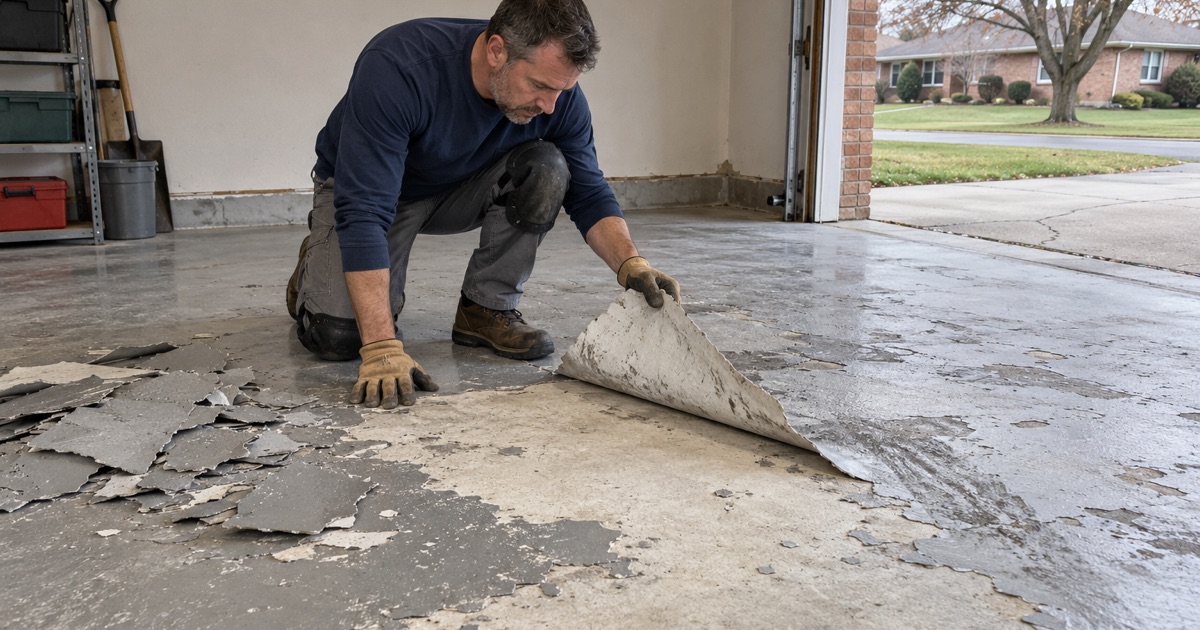
A peeling coating has to come off before any new floor goes down. We grind or shot blast failed epoxy and paint back to bare concrete, then look at why it failed. Most failures trace to prep, moisture or cure, and knowing which one tells us what the new system needs.
Moisture Problems Under Failed Coatings
Blisters, white residue or a coating lifting in sheets often point to moisture coming up through the slab. Before recoating, we test with an ASTM D4263 plastic sheet test, an ASTM F1869 calcium chloride test or ASTM F2170 relative humidity probes. High readings call for a moisture-mitigation primer, or for addressing water problems first.
When Repair Is the Wrong Answer
Settled, Heaved or Broken Slabs
A slab that has settled, heaved from frost or broken into pieces that rock underfoot has lost its support. Surface repair cannot fix that. We tell you when a slab needs replacement or mudjacking-type work before it can be coated, and we do not sell a coating as a structural fix.
Permits and Structural Work
Crack and spall repair is surface work, but slab replacement and structural alterations, including foundation repairs, appear on the City of Brookfield’s list of items requiring permits. When repair crosses into that territory, we ask City of Brookfield Inspection Services or the village inspector before scheduling, so the job starts on the right footing.
- 20+ Years Experience
- Moisture Testing in Every Scope
- Written Proposals and Contracts