
Brookfield Epoxy Flooring installs polished concrete floors in Brookfield, WI, serving surrounding cities including Wauwatosa, West Allis, Pewaukee, New Berlin and Menomonee Falls. After 20+ years of grinding concrete for coatings, we know how a slab behaves under the diamonds, and polished concrete is that skill taken all the way to a finished floor.
Polished concrete is not a coating. We grind the existing slab flat, harden it with a lithium silicate densifier and refine it through finer diamond grits until it carries a sheen of its own. With no film on top, there is nothing to peel, blister or wear through in the traffic lanes.
Every proposal names the grit sequence, the densifier, any guard and the target sheen, so the finished floor can be checked against what was quoted. A test area comes before any of it.
Commercial and Residential Polished Concrete
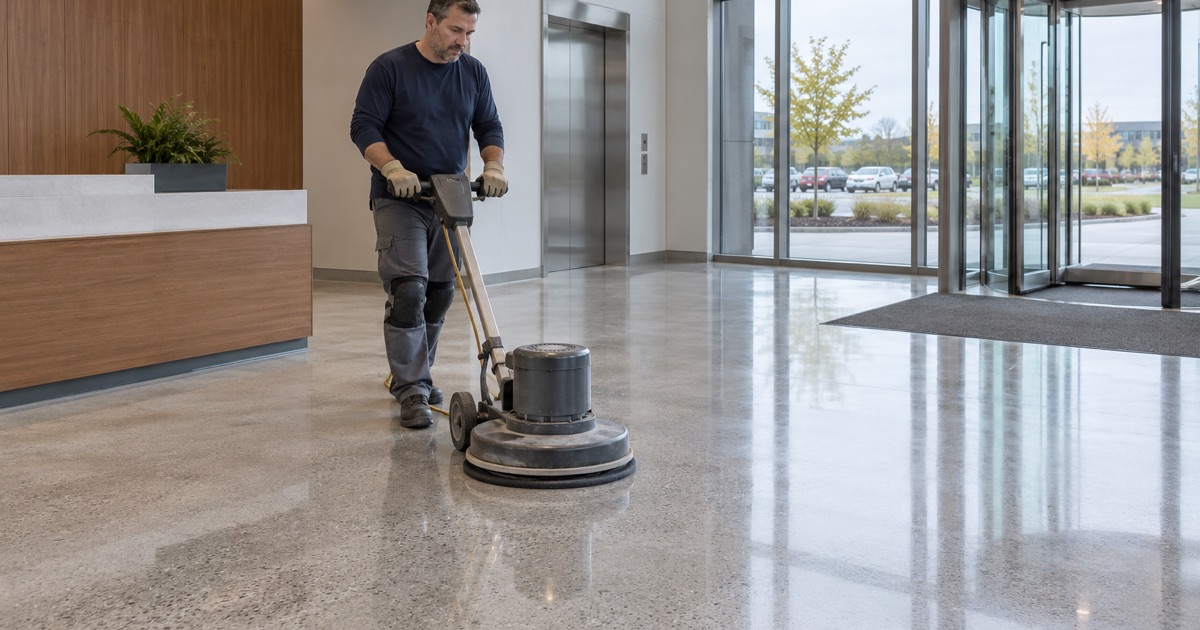
Retail Floors and Showrooms
Retail floors take carts, foot traffic and displays moving around them, and polished concrete handles all three with a bright, easy-to-clean surface. Around Brookfield’s Moorland Road retail corridor and business parks, a store or showroom can rarely shut down for long, so we schedule coarse grinding overnight and refine in phases.
Polished concrete also reflects light back into a space, which lets a store or showroom look brighter without new fixtures. The sheen level is chosen to suit the lighting and how much glare the space can take.
Warehouse and Light Industrial Floors
Warehouse and assembly slabs in Brookfield’s industrial parks see forklifts, pallet jacks and racking loads that will eventually wear through a thin coating. Polishing hardens and tightens the slab surface itself, so it holds up to wheeled traffic and sheds tire marks with a scrubber.
Joints are the weak point on a warehouse floor. We fill them with a semirigid joint filler so hard wheels cross without chipping the edges, and we plan the work around racking so operations keep moving.
Offices, Clinics and Common Areas
Lobbies, open office floors, clinic corridors and break rooms benefit from a floor with no grout lines and no coating to recoat on a cycle. We use quieter, dust-controlled equipment and phased schedules for occupied buildings, and we finish with a lower sheen where glare off windows would bother staff.
A clinic corridor also gets cleaned far more often than a store aisle, with disinfectants that can soften or haze a coating over time. A densified, polished surface takes that routine without a recoat cycle, and the seamless floor leaves no grout lines for grime to collect in.
Basements and Residential Living Spaces
In a home, polished concrete turns a basement slab into a finished floor that pairs well with rugs and radiant heat. It is not a coating, so it is less prone to failing from moisture vapor than a resin floor, though we still check for efflorescence and active water before starting.
A basement slab is rarely as flat or as clean as a commercial pour. Old adhesive, paint and patches show through polishing, so we test-grind a sample area and show you what your slab will look like before quoting the whole floor.
Aggregate Exposure and Finish Options
Cream, Salt-and-Pepper and Full Aggregate
How deep we grind decides how much stone shows. A cream finish stays at the surface paste, salt-and-pepper exposes fine sand and small aggregate, and full exposure cuts into the large stone. The deeper the cut, the more the slab’s own character shows, including any patches beneath.
The exposure level has to be decided before the first pass, because it cannot be undone. That is why the test area matters so much.
Sheen Levels From Matte to High Gloss
Sheen comes from how fine the last grit is. A lower final grit leaves a satin look, while continuing to 800 and then 1500 grit builds a reflective high gloss. We match the final sheen to traffic, lighting and how much visible wear the owner will tolerate.
A high-gloss floor in a busy entry will show scuffs and grit trails sooner than a satin one, while the same gloss in a quiet showroom reads as premium for years. We often recommend a lower sheen for the high-traffic lanes of a warehouse and a higher one for the customer-facing areas of the same building.
Dyes, Saw Cuts and Logos
Penetrating dyes add color without a film, from subtle earth tones to company colors. Saw-cut lines can divide a floor into a grid or border, and a logo can be dyed or stenciled into a showroom entry. Each is laid out before polishing, since cuts and dyes have to be placed into the process at the right stage.
Dyes respond to the slab underneath, so the same color reads differently on dense, hard-troweled concrete than on a softer, more porous pour. We dye a sample on the test area so the final color is something you have seen on your own floor rather than in a brochure.
How We Polish a Concrete Slab
Step 1: Test Grind and Assessment
We test-grind a small area, check flatness and hardness, and note cracks, joints and contamination. You see the actual finish before we quote the full floor.
Step 2: Coarse Grinding and Repair
Metal-bond diamonds flatten the slab and remove coatings, adhesive and laitance. Cracks and joints are filled at this stage, so the filler gets polished along with the floor.
Step 3: Densifying
A lithium silicate densifier is applied to react with the concrete and harden its surface. This is what lets the floor take a polish and resist wear and dusting.
Step 4: Honing and Polishing
Resin-bond diamonds refine the surface through progressively finer grits until the floor reaches the agreed sheen. Each pass removes the scratches left by the one before it.
Step 5: Guard and Final Burnish
A penetrating guard helps the surface resist staining, and a high-speed burnish brings out the final shine before the space returns to use. You get written care instructions the same day.
Polished Concrete Care and Site Practices
Dust and Slurry Control
Our grinders run on industrial dust extraction, and slurry from any wet work is collected on site. Brookfield’s sanitary system feeds MMSD on the east side and the city’s own Fox River Water Pollution Control Center on the west, which runs an industrial pretreatment program, so concrete fines never go down a floor drain.
In an occupied building, dust control is also about the people working there. We seal off the work area, run the coarse metal-bond passes after hours, and keep the extractors running through every grit, so the office or store opens the next morning without a film of gray dust on the shelves.
Daily Cleaning and Periodic Burnishing
A polished floor needs dust mopping and a neutral cleaner, not waxes or strippers. In heavy-traffic areas a periodic burnish restores the shine, and a light repolish of the final grits refreshes a worn lane without regrinding the whole floor.
Compared with a coated floor, that maintenance cycle has no recoat date. A polished floor kept clean simply keeps its finish, which is a big part of why retailers and warehouses choose it.
When Polishing Is the Wrong Answer
Polishing is not the fix for every slab. Concrete with heavy oil contamination, extensive patching, soft surface paste or widespread spalling may polish poorly, and a coating or an overlay can be the better choice. We read the slab before quoting and say so when it is not a polishing candidate.
The same goes for a floor that needs chemical resistance or a seamless sanitary surface, such as a commercial kitchen with hot washdown. There, a urethane cement or a resin system does a job polishing cannot. We would rather point you to the right floor than sell the one we happen to be quoting.
- 20+ Years Experience
- Moisture Testing in Every Scope
- Written Proposals and Contracts