
Brookfield Epoxy Flooring provides concrete grinding and surface preparation in Brookfield, WI, serving surrounding cities including Wauwatosa, West Allis, Pewaukee, New Berlin and Menomonee Falls. For more than 20 years, grinding has been the first step on every floor we install, because nearly every coating failure we have looked at began with a slab that was not properly prepared.
Concrete grinding uses rotating diamond tooling to remove coatings, adhesives, sealers and weak surface paste and to open the concrete to a measured profile. Shot blasting does a similar job by throwing steel shot at the slab. Both are mechanical, both leave a clean and consistent surface, and neither leaves chemical residue behind the way acid etching does.
We grind for our own coatings and polished floors, and we prepare slabs for other trades and products that need sound, clean concrete underneath them. The profile is matched to whatever goes on next.
Concrete Surface Profiles and Why They Matter
The ICRI CSP Scale
The International Concrete Repair Institute’s concrete surface profile scale runs from CSP 1, nearly flat, to CSP 10, very rough. Each coating, overlay and underlayment states the profile it needs on its data sheet. Thin coatings want a lighter profile, while thick mortars and overlays need a deeper one.
We match the tooling and the number of passes to the profile the system calls for, and we compare the finished slab against the profile chips the scale uses. That turns surface prep from a matter of opinion into something we can check.
Too Smooth, Too Rough
A slab that is too smooth gives a coating nothing to grip, and the coating peels. A slab that is too rough for a thin coating leaves ridges and valleys that show through, use more material and can trap air. Getting the profile right is the difference between a floor that bonds and one that fails.
Removing Laitance and Weak Paste
New concrete often has a weak, dusty top layer called laitance. Older slabs may have worn or contaminated paste. Coating over either means bonding to a layer that can peel away from the sound concrete beneath. Grinding removes it, so the coating bonds to strong concrete.
A simple scratch or tape test before and after grinding tells us whether the paste underneath is sound. When the surface keeps dusting or powdering after the first pass, we keep going until we reach concrete that holds, or we tell you the slab needs a densifier, an overlay or a different system.
Removing Coatings, Adhesives and Contamination
Old Epoxy, Paint and Sealers
Peeling epoxy, failing garage paint and old acrylic sealers all have to come off before a new floor goes down. We use coarse metal-bond diamonds, scrapers or shot blasting depending on the thickness and bond of what is there. Tightly bonded coatings sometimes take several passes.
After removal, we look closely at why the old coating failed. Moisture, poor prep and wrong products leave different signs, and knowing which one occurred tells us what the new system needs.
Carpet Glue, Mastic and Tile Adhesive
When carpet, vinyl or tile is removed, adhesive residue stays behind. These residues prevent new coatings and many flooring adhesives from bonding. We grind them off with tooling made to cut through sticky material without gumming up. Some older black mastics may contain asbestos and must be tested before grinding; we ask about the age and history of the floor before starting.
Oil, Grease and Tire Stains
Garage and shop floors often carry oil and grease soaked into the surface. Heavy contamination is degreased and ground out, and badly soaked areas may need to be cut out and patched. Coating over oil-soaked concrete invites peeling where the stain was.
Grinding and Shot Blasting Equipment
Diamond Grinders
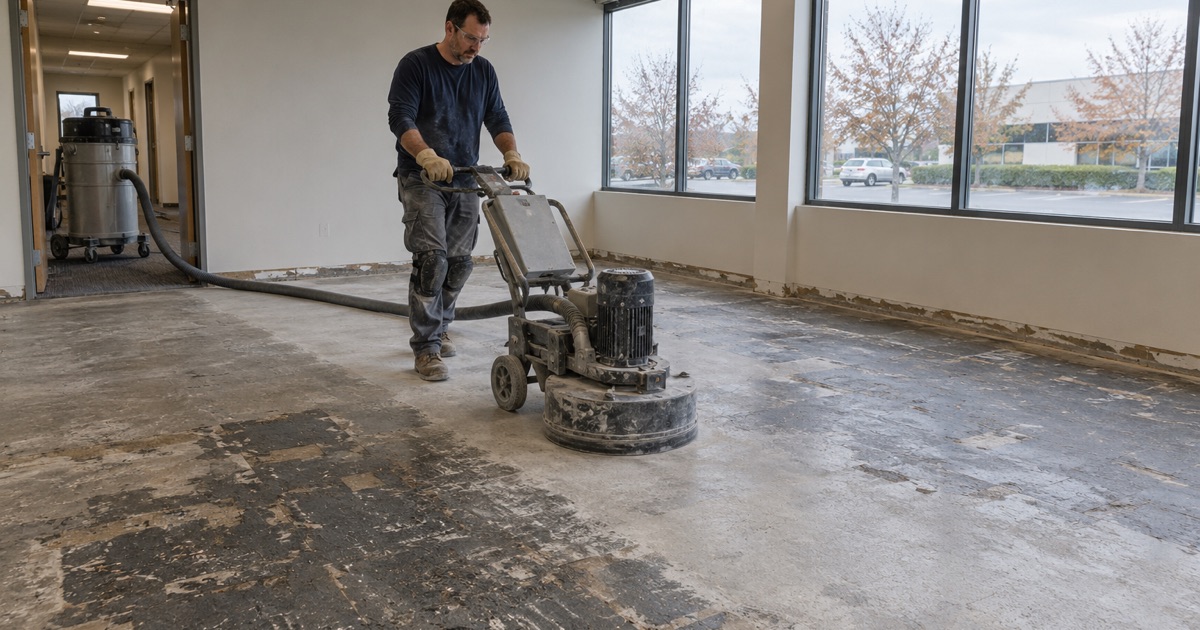
Walk-behind planetary grinders with metal-bond diamonds handle most garage, basement and commercial work. Hand grinders reach edges, corners and around drains. Changing the diamond bond and grit adjusts how aggressively the slab is cut.
The edges deserve the same profile as the middle of the floor. A coating that bonds well in the open field but sits on unground concrete along the walls tends to peel from the perimeter inward, so we hand grind every edge, step and drain surround rather than stopping where the big machine reaches.
Shot Blasting
Shot blasters throw steel shot against the slab and vacuum it back up for reuse, leaving a uniform textured profile. Shot blasting is fast on large, open areas such as warehouses and parking decks, and it suits systems that need a deeper profile.
Shot blasting does have limits. It cannot reach tight to walls, it struggles with soft or gummy coatings, and it can leave visible track lines if not run evenly. On most jobs we pair it with hand grinding at the edges, or choose grinding outright when the floor is small or crowded.
Dust, Slurry and Site Practices
Dust Control
Grinding concrete creates fine silica-bearing dust. Our grinders run attached to industrial dust extractors with filtration, and work areas in occupied homes and businesses are sealed off. Coarse grinding in businesses is scheduled outside operating hours.
Slurry Never Goes Down a Drain
Where wet grinding is used, the slurry is collected on site and disposed of, never washed into a floor drain or a storm sewer. Brookfield’s sanitary flow splits between MMSD on the east side and the city’s own Fox River Water Pollution Control Center on the west side, which runs an industrial pretreatment program to protect the plant and its collection system.
Moisture Testing After Grinding
Grinding opens the slab, which makes it the right time to test it for moisture. We run ASTM D4263 plastic sheet tests and, where the system calls for it, ASTM F1869 calcium chloride or ASTM F2170 relative humidity tests. The results decide whether a moisture-mitigation primer is needed.
This matters in Wisconsin homes, because the dwelling code exempts an unconditioned attached garage from the vapor retarder required under other floors. A garage slab that looks dry may have nothing under it to stop ground moisture, and a test on freshly ground concrete is the honest way to find out.
- 20+ Years Experience
- Moisture Testing in Every Scope
- Written Proposals and Contracts