Brookfield Epoxy Flooring installs flake epoxy floors in Brookfield, WI, serving surrounding cities including Wauwatosa, West Allis, Pewaukee, New Berlin and Menomonee Falls. Flake is the system we put down most often in garages, and with 20+ years of coating floors behind us, we know that how the chips look on day one depends on everything that happened to the slab before they were thrown.
A flake floor is a resin base coat with decorative vinyl chips broadcast into it while wet, scraped smooth once cured, and sealed under one or more clear topcoats. The result is a seamless, textured floor that hides dust and small wear, and cleans with a squeegee and a mop.
Your proposal names the product, the system build, the broadcast type and the finished thickness, so you can compare what goes down with what was quoted. Samples are laid on your own slab before you choose.
Flake Blends, Sizes and Broadcast Types
Choosing a Flake Blend
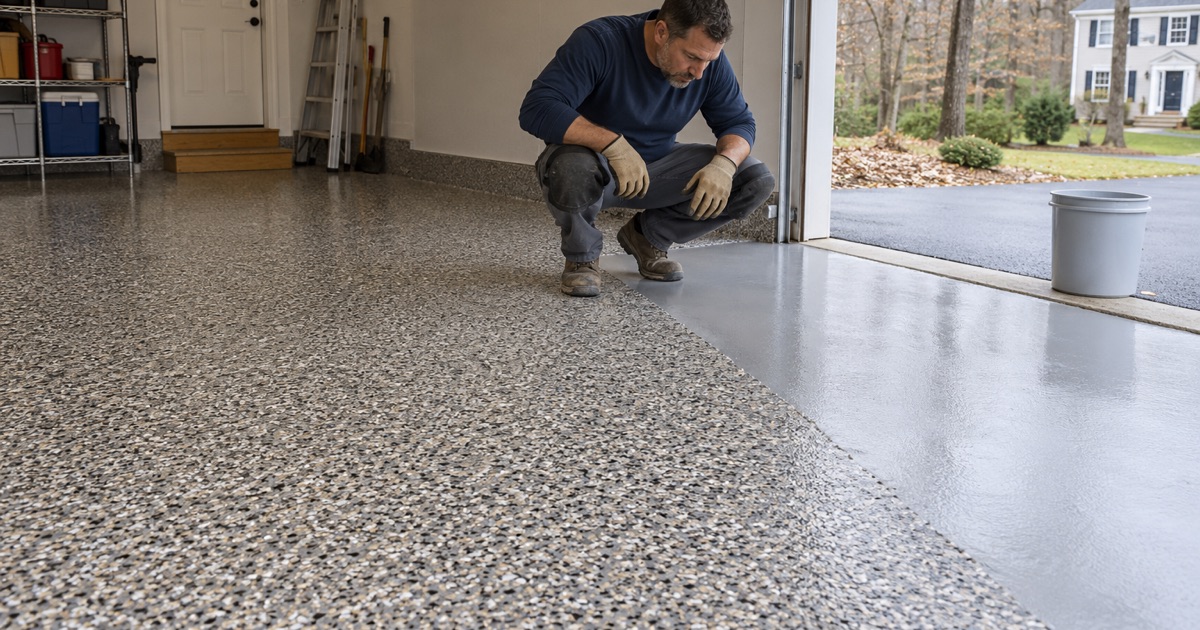
Vinyl flake comes in hundreds of blends, from neutral grays and tans to bold mixes with accent colors. Neutral blends hide dirt, salt residue and tire marks well, while high-contrast blends make a statement. We bring physical samples rather than relying on photos, because flake looks different under garage lighting than on a screen.
It helps to think about what the floor will see. A garage that takes salt all winter is best served by a blend with mid-tone grays, which hide the white haze salt leaves behind between washes.
Chip Size and Texture
Chip size changes both the look and the feel. Small chips create a fine, granite-like speckle and a smoother surface. Larger chips give bolder patterns and more texture underfoot. The size also affects how many topcoats it takes to reach the smoothness you want.
Larger chips also stand taller in the base coat, so they need a firmer scrape and usually an extra topcoat before the surface feels even. That adds a little material and time, and the proposal shows it, so the bolder look does not arrive with a surprise on the invoice.
Full Versus Partial Broadcast
In a full broadcast, flake is thrown into the wet base coat until it refuses to take any more, then the excess is swept and scraped. The base color disappears and the floor gains texture from wall to wall. In a partial broadcast, chips are scattered more lightly so the base color shows between them.
Full broadcast is the more durable choice for garages and shops because the chips add body to the system and protect the base coat. Partial broadcast suits rooms where a lighter look matters more than heavy wear.
Flake Floors for Garages
Built for Salt and Tires
A Brookfield garage takes rock salt, calcium chloride brine and meltwater all winter. A full-broadcast flake floor with a strong topcoat keeps that brine on top of the floor, where a squeegee moves it out the door, instead of letting it soak into the slab and scale it.
Tire lanes see the most wear. We build the system at full thickness with a 100% solids epoxy base and a polyaspartic topcoat, which resists hot tire pickup far better than a thin coat over etched concrete.
Traction in a Wet Garage
Flake texture helps with grip when snowmelt drips off a car. The number of topcoats sets how much texture remains. Fewer coats leave more grip, while more coats give a smoother, easier-to-clean floor. We can also add fine aggregate to the topcoat in walking lanes for extra traction.
The door apron needs its own thought. Plows, shovels and ice-scrapers all hit the slab at the garage door, and that edge is where flake floors chip first. We key the coating into a clean saw cut or ground edge at the door rather than feathering it thin, so the termination holds up to winter.
Flake Floors for Basements, Shops and Commercial Spaces
Basement Rec Rooms and Laundry Areas
In a basement, a flake floor brightens the room and handles spills, toys and laundry water. The slab gets moisture tested first, because basement slabs often carry vapor from below. Where readings call for it, a moisture-mitigation primer goes under the flake system.
When a flake floor is part of a basement being finished into a rec room, the City of Brookfield permit for that finish sets the schedule. We ask Inspection Services, or the village inspector in a neighboring community, how the floor fits before booking it.
Workshops and Hobby Spaces
Home and commercial workshops benefit from flake floors that hide small stains and stand up to dropped tools and rolling equipment. We choose topcoats with good chemical resistance where oils and solvents are used.
In a commercial shop, control joints are filled with a semirigid joint filler before the flake goes down, so cart and lift wheels do not chip the edges and crack the coating along the joint line.
Break Rooms, Restrooms and Back-of-House Floors
In commercial buildings, flake systems work well in break rooms, restrooms, locker rooms and stock rooms. The seamless surface is easy to clean, and an integral cove base can carry the floor up the wall in wet areas. For heavy wet use or chemical exposure, we may recommend quartz or urethane cement instead.
How a Flake Floor Is Installed
Grinding and Repair
The slab is diamond ground with dust extraction, never acid etched, to open it to the profile the base coat needs. Cracks and spalls are filled and ground flush, and joints are either filled or honored. We read the slab before quoting and say plainly when it needs more than surface repair.
Base Coat and Broadcast
After priming, the pigmented base coat is rolled out and flake is broadcast into it while it is wet. Timing matters, and we check slab temperature and dew point that morning, because a base coat that cures too slowly or in damp conditions can trap moisture or develop amine blush.
Scraping and Topcoating
Once the base has cured, loose chips are swept up and the floor is scraped with a hard blade to knock down standing chip edges. Then a clear topcoat, often polyaspartic for UV stability and wear resistance, is applied. You get written walk-on and park-on times from the product’s cure data.
- 20+ Years Experience
- Moisture Testing in Every Scope
- Written Proposals and Contracts